
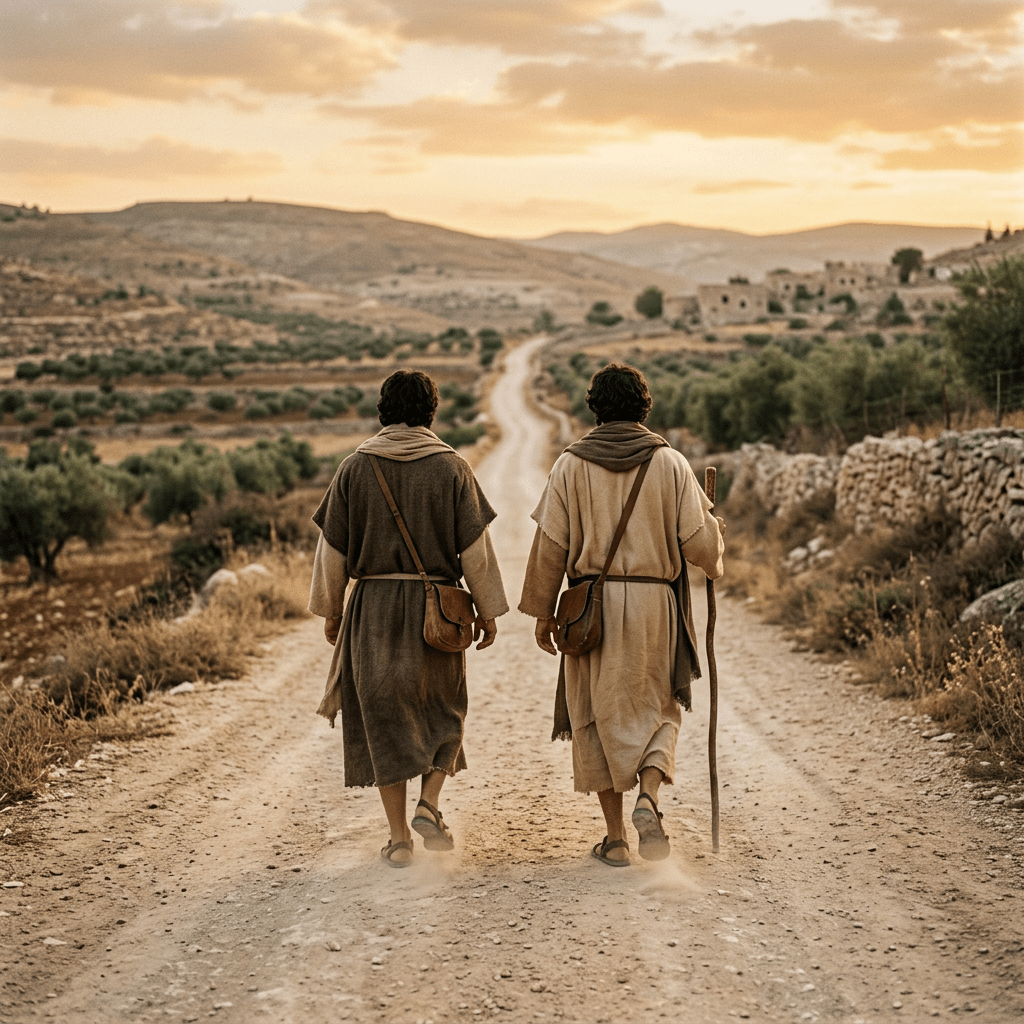
A homily for the Third Sunday in Easter, Year A (Luke 24:13-35)
You can watch the homily here.
There is a quiet honesty in this Gospel that feels almost too familiar.
Two disciples are walking away.
Away from Jerusalem.
Away from the place where everything fell apart.
Away from hope that didn’t turn out the way they thought it would.
“We had hoped…” they say.
And if we’re honest, that phrase carries a lot of weight.
We had hoped things would be different.
We had hoped for healing that didn’t come.
We had hoped for leadership that would unite instead of divide.
We had hoped that violence in our neighborhoods, our schools, our lives, would end.
We had hoped for a church that felt clearer, stronger, more certain.
“We had hoped…”
And so they walk. Not toward faith, but away from it.
And here is the first surprising thing about this story:
Jesus does not wait for them to turn around.
He does not stand back in Jerusalem and say, “Come find me when you get it right.”
He meets them on the road they should not be on.
He meets them in their confusion.
In their misreading of everything that has happened.
In their disappointment.
And he walks with them.
That alone is good news.
Because it means that whatever road we find ourselves on—whether it is grief, cynicism, exhaustion, or just quiet numbness—we are not walking it alone.
Even when we are heading in the wrong direction, Christ draws near.
Even when we are heading in the wrong direction, Christ draws near.
And as he walks with the disciples, notice Jesus does not correct them. He asks questions.
“What are you discussing?” “What things?”
He lets them tell their story—their version of events, even though it is incomplete, even though it is shaped by disappointment and misunderstanding.
This is true spiritual companionship. This is the nature of Christ.
Before resurrection is proclaimed, grief is honored.
Before truth is clarified, their experience is heard.
I truly believe that this is part of our calling, too—not to rush people past their pain, not to focus on ‘fixing’ before we have even made space for the truth of what they are carrying.
This practice is desperately needed. Because in a city like ours, people are carrying a lot.
Fear.
Anger.
Weariness.
Questions about whether things will ever really change.
And the church is not called to ignore that.
We are called to listen—because Christ listens first.
Only then does Jesus begin to open the scriptures.
Not as a lecture. Not as a correction meant to shame them.
But as a re-telling of the story.
A bigger story.
A story in which suffering is not the end.
A story in which what first looked like failure is, somehow, the very place where God is already at work.
He doesn’t erase their disappointment—he reframes it.
And that matters.
Because many of us don’t just need comfort—we need a new way of seeing.
A way of perceiving where God is still present in a fractured world.
Where resurrection is not the denial of suffering, but God’s work within it.
Yet still—they do not recognize him.
Not on the road.
Not in the teaching.
It is only when they sit down, when they are still, when bread is taken, blessed, broken, and given—that their eyes are opened.
It happens in something ordinary.
A table.
A meal.
A shared moment.
And then—just as quickly—he is gone.
Which reminds us that we do not control how or when we recognize Christ.
We cannot manufacture certainty.
But we can pay attention to the ordinary places where Christ has promised to be—
in scripture,
in community,
in the breaking of bread.
And then comes one more quiet miracle.
They turn around.
The same road that carried them away now carries them back.
Back to Jerusalem.
Back to community.
Back to the others.
Nothing external has changed.
The world is still uncertain.
The risks are still real.
The questions are not all resolved.
But they have seen enough.
Or maybe—more truthfully—they have been seen, and that is enough to send them back.
Perhaps this Gospel is not a story about finding Jesus once we get everything right.
Perhaps it is a story about Jesus finding us when we are walking away.
When our theology is shaky.
When our hope is thin.
When our direction is unclear.
And walking with us anyway.
Opening something in us, slowly.
Meeting us in ordinary moments.
And, in time, turning us—gently, persistently—back toward life.
And if that is true, then resurrection is not just something that happened once.
It is something that is still happening.
On roads like ours.
In conversations like ours.
At tables like this one.
So when you find yourself saying, “We had hoped…”
Pay attention. Because Christ is already walking beside you.



 the minute monk
Leave a reply to Joy Duperault Cancel reply