
A homily for Proper 23, Year A | Isaiah 25:1-9, Philippians 4:1-9, Matthew 22:1-14
There is a beautiful thread running through our readings this morning.
A feast.
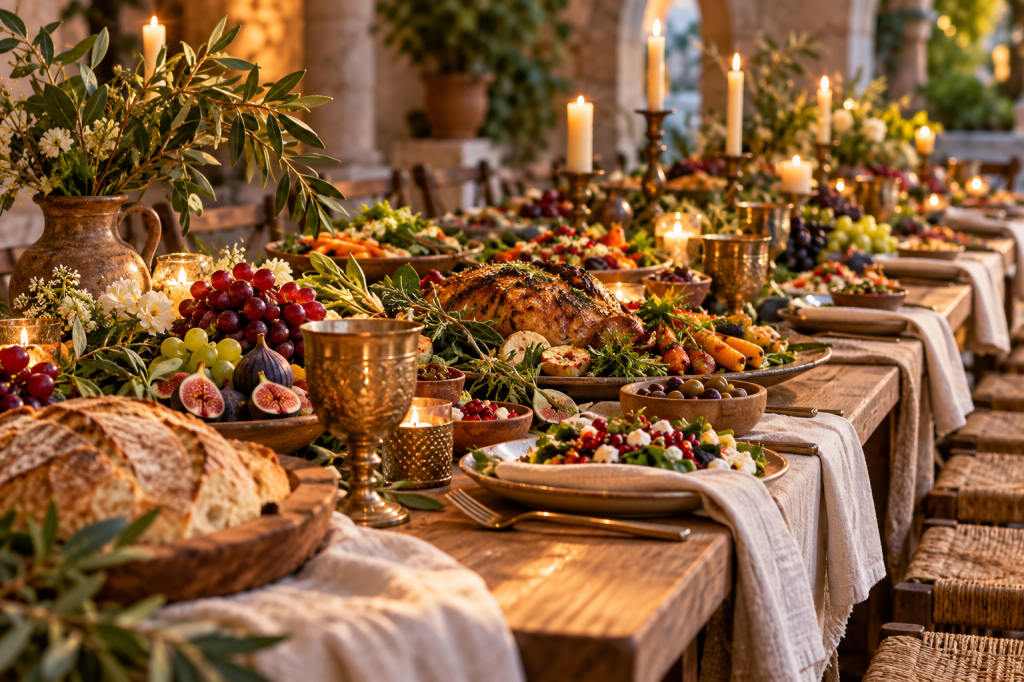
Isaiah gives us a vision of God preparing a feast for all peoples—a feast of rich food and well-aged wine, a feast where death is swallowed up forever, and where tears are wiped away.
And Jesus tells us about a wedding banquet.
Again, there is a table. There is an invitation. There is more than enough.
The kingdom of heaven, Jesus says, is like a king who prepares a wedding banquet for his son.
And then something extraordinary happens– every host’s nightmare. The guests don’t show.
So the king sends the invitation out again. And when the expected guests still refuse, the invitation gets wider. Go into the streets. Find whoever you can and bring them in. We are having this party!
And Matthew tells us that they gathered everyone they found, “both good and bad.” The banquet hall is filled. I think there is something profoundly important about that detail.
The kingdom of God is not a private dinner. It is not an exclusive club. It is not a reward for people who have successfully demonstrated that they are good enough. It is a feast for all peoples. And the invitation is meant to keep going outward.
We are not only the people who have been invited. We are also the people who have been sent to invite others. We have received God’s hospitality so that we might become people of hospitality. We have been fed so that we might feed. And we have been gathered around this table so that we might become people who spend our lives making room at the table.
And then we have this strange image of the wedding garment.
We don’t really know exactly what Jesus means by it. It has stirred countless interpretations. But perhaps we can hear it as an image of transformation. The invitation is free. We don’t earn our way into the banquet. But once we have received the invitation, we begin to be changed by it. We begin to put on the life of Christ. And that means we begin to see the world differently.
Paul gives us a glimpse of what that might look like: “Let your gentleness be known to everyone.” Pray. Give thanks. Seek what is true, honorable, just, and worthy of praise. And then, he says, “Keep on doing the things that you have learned and received and heard and seen.”
Keep practicing.
Keep becoming.
Keep living as people who know they have been invited to the feast.
This is one of the things I find so compelling about the Christian tradition of religious life.
Some of you may not be familiar with religious life in the Episcopal Church. You may think of monks and nuns living in monasteries, as a particularly Roman Catholic expression, but we do have them in our denomination as well, and monasteries are one expression of vowed life. But there are others.
There are Episcopal religious communities whose members live in the midst of the world—in parishes, neighborhoods, workplaces, families and ministries—and who nevertheless make vows and intentionally order their lives around prayer, community, service, and a Rule of Life.
I am part of one of those communities: The Community of the Mother of Jesus.
We are a dispersed community. We don’t all live under one roof but we do live under one Rule. We live our vocation where God has placed us, while being bound together by prayer, common practices, vows, and a commitment to serve our neighbors in need.
And my community’s life is built around four vows: Justice. Tenderness. Humility. And Contemplation.
You might think of these vows as four ways of learning to live as people who have been invited to the feast.
Contemplation teaches us to recognize that the table belongs to God and noticing that God is already here. Humility reminds us that we are guests before we are hosts. We didn’t prepare this feast God did. We are not the saviors of the world. Christ is. Tenderness teaches us how to welcome the person who comes through the door carrying wounds we cannot see. And Justice asks a harder question:
Who isn’t at the table?
Who was told there wasn’t room?
Who has been pushed to the margins?
Who is still standing outside in the cold?
Because if Isaiah is right—and I believe he is—God’s feast is for all peoples.
That means Christian hospitality cannot simply mean being friendly to the people who already feel comfortable here. It means learning to notice who is missing. It means being willing to move the table. Sometimes it means setting another place. Sometimes it means leaving the banquet hall and going out into the streets to find someone who has stopped believing that there is a place for them. And sometimes justice means discovering that the table itself has been arranged in a way that keeps some people standing.
That is where religious life has something particular to offer the Church.
Not because religious people have figured all of this out. We have not.
But religious communities make a particular promise to remain and keep asking the questions.
How do we seek God?
How do we put our prayer into practice?
How do we make hospitality more than a pleasant word?
How do we live in such a way that our lives themselves become an invitation?
For us in CMJ, that is part of what it means to “serve the neighbor in need.” Prayer and justice are not competing activities. They belong together. Because prayer, if it is genuine, teaches us to see the world differently.
The stranger becomes a neighbor.
The person who is difficult becomes someone who bears the image of God.
The hungry person becomes someone who belongs at the feast.
And then justice becomes more than an abstract principle. It becomes a response to love.
Our community’s motto comes from the wedding feast at Cana: “Do whatever he tells you.”
Mary doesn’t tell the servants what the whole plan is. She simply tells them to listen. To pay attention. To respond.
That is what discipleship really is. Paying attention to where Christ is asking me to make room.
We live in a world where there are plenty of reasons to believe that there isn’t enough.
Not enough food.
Not enough housing.
Not enough dignity.
Not enough forgiveness.
Not enough love.
But the Gospel tells us something radically different. The feast is ready. There is enough. God’s table is bigger than we imagine. And our calling is not to guard the door. It is to help open it.
So when we come to this Eucharistic table today, perhaps we can hold together both sides of the invitation.
First: Come to the feast. Come with your wounds, your questions, your failures, your hunger.
And then, having been fed: Go from this place to where people are lonely and hungry.
Go to the places where people have been told they don’t belong.
And invite.
Make room.
Set the table.
Perhaps not perfectly but sincerely. And become people who by encountering the love of God can say: There is room for you here. You are welcome.
The feast is ready.




Leave a Reply